
First Missionaries in Hawaii

To watch on Youtube click here: https://youtu.be/xVqNsL22UPs
To listen on Spotify click here: https://creators.spotify.com/pod/profile/krystine-stephenson/episodes/Hawaii-Stories--George-Q-Cannon-Knowing-God-first-missionaries-in-Hawaii-LDS-Church-History-e373rbv
The Church of Jesus Christ of Latter-day Saints is a well established religion on the Islands of Hawaii today, previously known as the Sandwich Islands. With two operating temples(the Laie Hawaii Temple and the Kona Hawaii Temple) and two more Temples announced(the Kahului Hawaii Temple and the Honolulu Hawaii Temple). The accounts of the early Latter-day Saints and the first missionaries are full of determination and faith. In the very beginning of the restoration of the gospel of Jesus Christ, the first group of missionaries sent to the Sandwich Islands, later known as Hawaii, experienced great hardships, and abandoned their mission. One missionary, of the group, knew God had a glorious plan for the people of Hawaii and made the difficult decision to stay while the mission president moved on to a new location. This young missionary was George Q. Cannon, future member of the Quorum of the Twelve Apostles. His reliance of God helped him withstand the difficulties and stay to help the Hawaiian people learn of the restored gospel of Jesus Christ.
Under the direction of the Prophet Brigham Young, ten missionaries of The Church of Jesus Christ of Latter-day Saints arrived in Hawaii on December 12, 1850. The day after arriving in Hawaii this group of missionaries climbed a nearby mountain, built an alter and dedicated the Hawaiian islands for the preaching of the gospel of Jesus Christ in the latter-days.
George Q. Cannon recorded this of the even:
"When we got near to where we wanted to stop we picked up a stone apiece and carried [it] up with us. . . we then made an alter of our stones <and sung a hymn> then we all spoke round what our desires were; & selected Bro. Hyrum Clark to be mouth [to the prayer]. We had the spirit with us I could feel it very sensibly. Our desires principally <were> that the Lord would make a speedy work here on these Islands and that an effectual door might be opened for the preaching of the gospel."
Even though, this group of missionaries were excited about the prospect of finding and teaching people on the Hawaiian Islands, they struggled to make headway on the islands. The missionaries found much opposition while trying to teach the gospel. With the lack of success the group of missionaries decided that Hawaii was not where they should be and half of the missionaries moved on to different locations. They believed Hawaii was not ready for the gospel.
One of the missionaries was the young George Q. Cannon, a future members of the Quorum of the Twelve Apostles and the nephew of Prophet John Taylor. When George was presented with the prospect of leaving Hawaii to move onto different location, George did not feel good about it. Although, young George believed the Lord called him to Hawaii to accomplish a mission and did not want to leave until this mission was accomplished.
He later recorded:
"I felt resolved to stay there, master that language and warn the people of those island, if I had to do it alone; for I felt that I could not do otherwise."
While serving in Maui Cannon recorded that Clark, his mission president, had arrived on Maui and bore testimony to Cannon and his companions that he had learned from the Lord that there was "nothing to be done" on O'ahu and the group of missionaries should leave the islands of Hawaii and head to the Marquesas Islands, French Polynisia.
Cannon recorded in his journal that Clark told the Maui missionaries that “if things were the same here as they were up at O’ahu, he thought it would be best for us to go down with him.” However, Cannon noted, “We felt upon thinking the matter over as though we could not leave this place uncondemned.” Indeed, his feelings were the same as he had expressed on O‘ahu: “I considered that I would have been just as much justified in leaving the first day as I would now, that we had not given the people a trial whether they would receive it or reject it, and we had no such testimony as Bro. Clark. In fact every time I had prayed to the Lord that their [sic] might be a good work done here I had felt my bosom warm and felt the spirit continually whispering to me if I should persevere I should be blest.”
Cannon recorded:
“Our position, just then, was a peculiar one. Here was our president, the man who had been appointed to counsel and guide us, proposing to us to leave the field to which we had been appointed, and to take a journey of several hundred miles to another land to labor. What were we to do? How far did the obedience which we owed to him require us to go? This was an important question. To disobey a man in the rightful exercise of authority, was an act from which we naturally recoiled. . . . But we felt that it would not be right for us to leave that island then.”
The mission president did not push the missionaries to follow him, only suggested it. George Q. Cannon had felt that God was aware of the situation and was prompted to continue to teach the people of Hawaii, even if he had to do it alone. From his confirmation of the Spirit, George Q. Cannon knew for a surety that the efforts to teach the people of Hawaii would not be wasted. Through amazing life changing experiences George Q. Cannon was assured that God was with him, and the importance of his mission.
Being left without a mission presidents guidance George had to trust in the Lord to guide him for food, shelter, and clothing. He was not fluent in the Hawaiian language and pled to the Lord for the gift of tongues. George knew of the importance of learning the language of the people he served. The efforts that he put in and prayed for, to understand and speak the language paid off over time.
While learning the language, and not being able to communicate well with the Hawaiian people, George decided to use his time to study The Book of Mormon. When he first arrived in Hawai‘i, an initial lack of success and his inability to understand the Hawaiian language gave him extra time with the scriptures.
He later recalled:
"It was then that I found the value of the Book of Mormon. It was a book which I always loved. But I learned there to appreciate it as I had never done before. If I felt inclined to be lonely, to be low spirited, or homesick, I had only to turn to its sacred pages to receive consolation, new strength and a rich outpouring of the Spirit. Scarcely a page that did not contain encouragement for such as I was. The salvation of man was the great theme upon which its writers dwelt, and for this they were willing to undergo every privation and make every sacrifice. . . .
Let me recommend this book, therefore, to young and old, if they need comfort and encouragement. Especially can I recommend it to those who are away from home on missions. No man can read it, partake of its spirit and obey its teachings, without being filled with a deep love for the souls of men and a burning zeal to do all in his power to save them. . . .
What were my petty difficulties compared with those afflictions which they had to endure? If I expected to share the glory for which they contended, I could see that I must labor in the same Spirit. If the sons of Mosiah could relinquish their high estate, and go forth among the degraded Lamanites to labor as they did, should not I labor with patience and devoted zeal for the salvation of these poor red men, heirs of the same promise?"
George Q. Cannon came to know God during his time in Hawaii. On one occasion, while praying in a garden behind Nalimanui’s home, President Cannon received a powerful divine manifestation so sacred to him that he seldom mentioned it in public and never supplied details. Later, though, he recorded that God “revealed himself to me as he had never done before. … Many things were revealed to me during those days, when he was the only friend we had to lean upon. A friendship was thus established between our Father and myself, which I trust will never be broken or diminished. … He condescended to commune with me, for I heard his voice more than once as one man speaks with another.”
Towards the end of his life George Q. Cannon wrote this in the Deseret Evening News, on October 6, 1896, saying:
“I know that God lives, I know that Jesus lives; for I have seen him. … I testify to you of these things as one that knows — as one of the Apostles of the Lord Jesus Christ.”
While speaking of this powerful testimony of George Q. Cannon, scholar Daniel Petersen wrote that Lahaina, on Maui, may have been President Cannon’s personal “sacred grove.”
During an 1893 meeting in the newly completed Salt Lake Temple, he testified that he had “seen and conversed with Christ as a man talks with his friend,” “face to face.”
On his deathbed in 1901, President Cannon assured his son that he knew that God lived because he had heard his voice.
In March 1851, he traveled via the Iao Valley from Lahaina to Wailuku, where he met and baptized a prominent Hawaiian judge named Jonathan (or Jonatana) Napela. George believed that meeting Napela was an answer to his fervent prayers. Napela helped tutor Cannon in learning the Hawaiian language and worked with him to translate the Book of Mormon into Hawaiian—the first translation of the book into a non-European language. Napela also proposed the first plan for a program to train Latter-day Saint missionaries in the language of their assigned field: a school where new arrivals would spend two months studying the language before dispersing to fulfill their assignments.
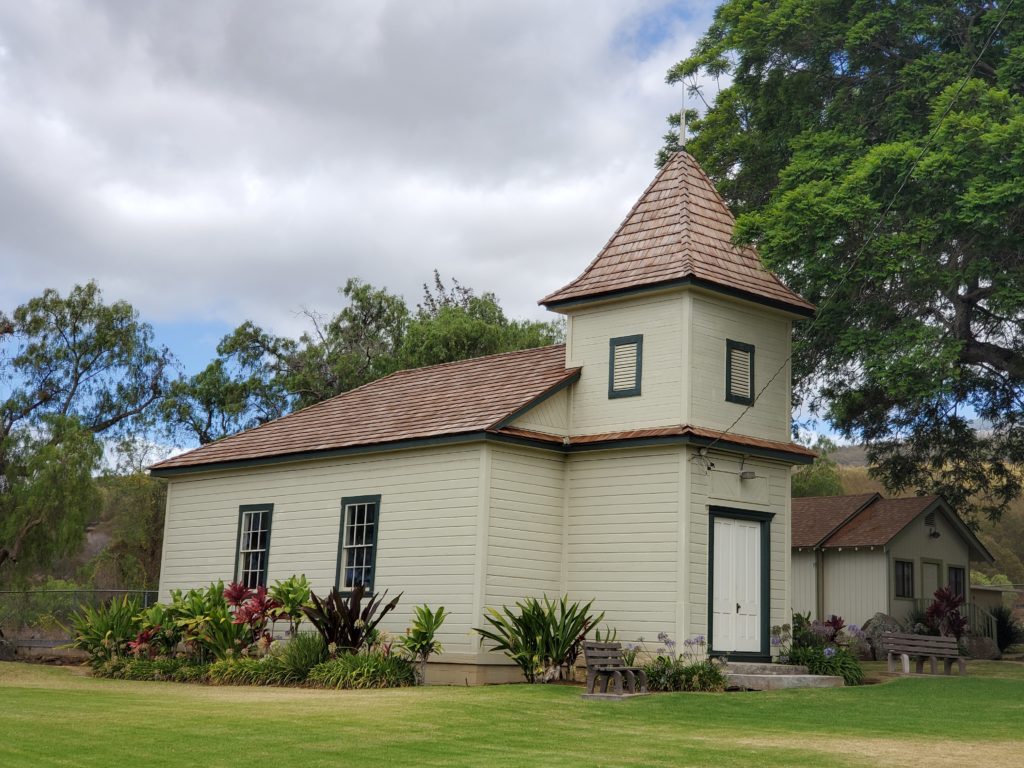
With Napela’s help, President Cannon established himself in the area of Pulehu, a settlement in the Kula district on the volcanic slopes of Haleakala. Under Cannons leadership in 1852, the community built a one-room chapel that is older than the Salt Lake Tabernacle and still stands today, a special place for members.
The Savior Jesus Christ knew who was needed and when to teach God children in the Hawaii Islands. The Lord knew that George Q. Cannon would be the perfect young missionary to work through the hardships of the area and meet the people the Lord himself had prepared. The Lord is gathering His people in all parts of the world, and Hawaii was one of the first places for the gathering. This land has a sacred heritage, with the foundation of faith laid by the Lords faithful. This beautiful story of the gathering of the Lord Children of Hawaii Hawaiian started with a handful missionaries willing to listen to the will of God not willing to give up, and the sweet, spiritually-sensitive Hawaiian people ready to give all to follow the Lord Jesus Christ in His restored Gospel.
References:
"The Laie Hawaii Temple, A Century of Aloha" Chapter 1
min 19 Presidents of the Church book by Truman G. Madsen
https://www.churchofjesuschrist.org/study/history/topics/jonathan-napela?lang=eng
Related Posts
The Pan Filled With Food
September 21, 2026
Art by: Clark Price To watch on Youtube click here: https://youtu.be/EvyfKZ1vbhY To listen on Spotify click here:...

The Women Who Helped Save the Book of Commandments
September 2, 2026
The horrendous persecution heaped upon the Latter-day Saints was once common knowledge but many today downplay the persecution. Some say the...

The Other Eminent Men of Wilford Woodruff
June 5, 2026
Artwork credit: Vision of Wilford Woodruff, by Ken Corbett To watch on Youtube click here: https://youtu.be/vMDMss6lGrQ To listen on Spotify click...

Salt Lake Temple Stories: Cornerstone Ceremony of the Salt Lake City Temple
May 23, 2026
To watch on Youtube click here: https://youtu.be/QE6ldwnyGJU To listen on Spotify click here:...

Spencer W. Kimball's Heart Operation by Russell M. Nelson
March 20, 2026
To listen on Spotify click here: To watch on Youtube click here: https://youtu.be/Op5lef0Ljug While in Manchester England, in 1971, Spencer W....

Pentecostal Outpourings in Kirtland Ohio, Presendia Kimball
March 9, 2026
To listen on Youtube click here: https://youtu.be/UIiUToXpjJ8 To listen on Spotify click here:...

Salt Lake Temple Stories: Who Really Designed The Salt Lake Temple??
March 7, 2026
To listen on Spotify click here:https://open.spotify.com/episode/5X1P56qpAaREK7jYtz2CkU?si=lwwvwb-HSsCCtvM0u7VgSg To watch on Youtube click here:...

Salt Lake Temple Stories: Architect of The Salt Lake City Temple
February 6, 2026
To watch on Youtube click here: https://youtu.be/AkT_HW097Uo To listen on Spotify click here:...

Salt Lake Temple Stories: Groundbreaking Ceremony of The Salt Lake City Temple
January 10, 2026
To watch on Youtube click here:https://youtu.be/wC7mANy9W8w To listen on Spotify click here:...

Laie Hawaii Temple Family History Miracles
October 5, 2025
To watch on Youtube click here: https://youtu.be/gi7dAjktIOs To listen on Spotify click here:...